Recovering from Kyber Ransomware on VMware ESXi Hypervisors
Executive Summary
Cohesity REDLabs has released updates to its threat library in response to the active exploitation of VMware ESXi hypervisors and Windows servers by Kyber ransomware. Unlike typical ransomware that focuses on individual endpoints or file servers, Kyber deploys coordinated payloads against ESXi hypervisors and Windows file servers in the same environment — encrypting virtual machine datastores, defacing management interfaces, and executing an anti-recovery playbook that targets local Windows restore paths including Volume Shadow Copies and backup-related services. Cohesity REDLabs has analyzed Kyber and verified recovery via Cohesity products and detection using Cohesity Data Cloud Enterprise Edition security features in the May REDLab Newsletter.
Kyber surfaced in late 2025 and accelerated through Q1 and Q2 2026, with a March 2026 incident response engagement by Rapid7 confirming coordinated deployments against both Windows and ESXi infrastructure inside the same victim environment. The group markets its encryptor as “post-quantum” using Kyber1024 key encapsulation — a claim that holds up only partially on Windows and is demonstrably false on the ESXi variant, which actually relies on ChaCha8 with RSA-4096 key wrapping. The branding is more interesting than the cryptography. What matters operationally is the design choice: one successful detonation against a hypervisor cluster can take an entire production fleet dark in minutes.
For Cohesity administrators, this is a backup-platform problem before it is a hypervisor problem. If your VMware backup data is immutable, isolated, and verifiable, Kyber is a bad week. If it is not, Kyber is an existential event. This advisory explains how Kyber operates, why it matters for data protection teams, and what Cohesity administrators should do right now — in coordination with infrastructure, virtualization, and security colleagues — to a ensure that immutable backups remain the organization’s reliable recovery path.
Why Kyber Is Especially Concerning for Virtualized Environments
Several characteristics distinguish Kyber from typical endpoint ransomware. Hypervisor-native encryption affects every VM on the host simultaneously rather than one server at a time. Management plane disruption removes the primary ESXi admin tooling teams rely on during an incident, while dual-platform coordination closes file-level and virtualization-level recovery options at the same time. Because access is identity-driven rather than exploit-driven, no hypervisor patch alone resolves the root cause. Kyber is a highly sophisticated operation, and its TTPs may propagate to larger ransomware groups targeting virtualized enterprise environments.
Technical Details of Kyber
Kyber surfaced in October 2025 across leak-site and threat intelligence reporting, initially profiled by CYFIRMA as a conventional encryptor with aspirations toward structured data extortion. The group’s targeting skew — aerospace and defense, government contractors, technology and engineering firms across the United States, Western Europe, and Australia — is consistent with an operator seeking high-leverage victims rather than spray-and-pray volume.
Attack Flow
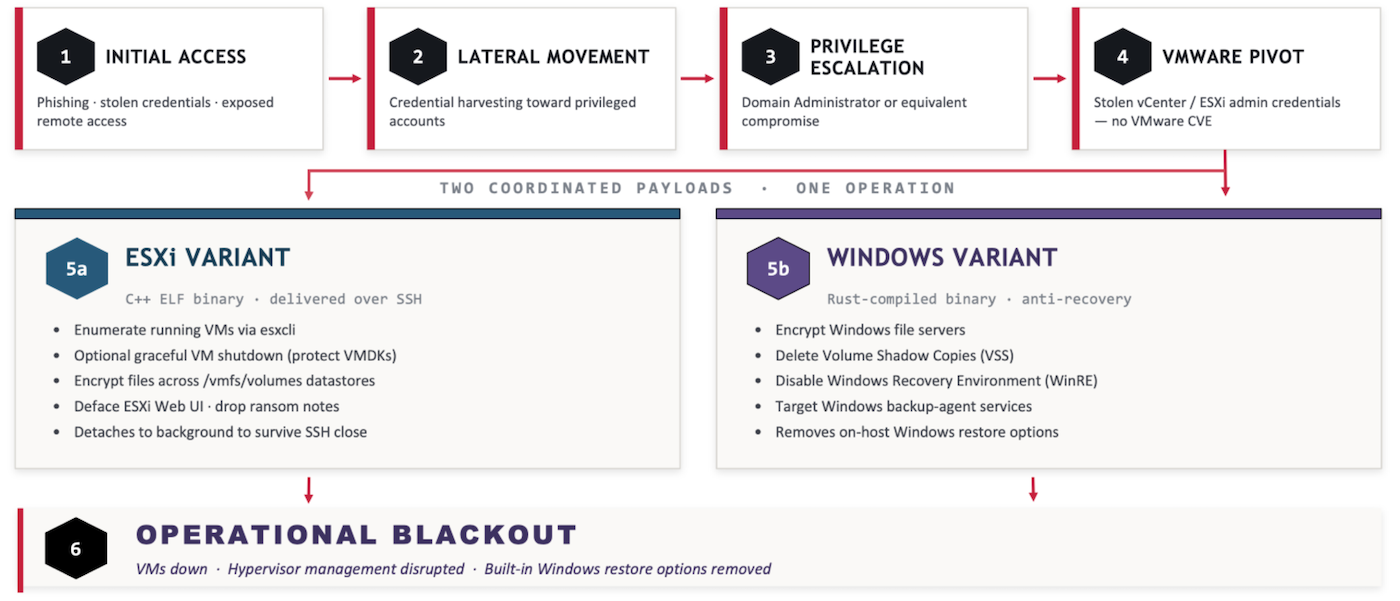
The attack typically starts with initial access through phishing, stolen credentials, or exposed remote access, followed by lateral movement across the environment as the attacker harvests additional credentials and escalates toward high-privilege accounts. With domain-level control established, the operator pivots deliberately into the VMware management layer, abusing stolen vCenter or ESXi administrative credentials rather than exploiting a VMware vulnerability. From this position, Kyber deploys two coordinated payloads in the same operation.
ESXi Variant
The ESXi variant is a C++ ELF binary delivered over SSH. It uses native VMware tooling such as esxcli to enumerate running virtual machines, optionally shut them down gracefully to avoid corrupting VMDK files, and then encrypts files across /vmfs/volumes datastores. For each target file, it generates a 40-byte key/IV pair, wraps that key using an embedded RSA-4096 public key, and encrypts the file in-place in 1 MB chunks. On successful encryption the file is renamed from a transient .processing extension to .xhsyw. The variant replaces the ESXi Web UI index pages so administrators encounter a ransom note before they can authenticate, writes extortion messages directly to datastore paths, and can detach into a background process to continue encryption after the SSH session closes. Despite the group’s branding, the ESXi encryptor does not implement Kyber1024 key encapsulation; it uses ChaCha8 as the stream cipher with RSA-4096 wrapping the per-file key. Rapid7’s analysis is explicit that the post-quantum claim on this variant is marketing.
Windows Variant
In parallel, the Windows variant — a Rust-compiled binary — encrypts file servers and executes an aggressive anti-recovery playbook. It does implement the advertised hybrid scheme combining classical and post-quantum primitives, but the cryptographic novelty is secondary to its pre-encryption behavior: it deletes Volume Shadow Copies, disables Windows Recovery Environment (WinRE) and Windows boot repair, terminates SQL Server, Exchange, and backup-related services, clears Windows event logs, and empties the Recycle Bin. There is an experimental Hyper-V targeting path the authors flagged in their own code. The shared campaign identifier and Tor infrastructure across both samples confirm the operator deploys them in tandem — the Windows build erodes endpoint recovery options while the ESXi build collapses the virtualization tier. The combined result is an operational blackout: production VMs are unavailable, hypervisor management is disrupted, and local Windows recovery paths are destroyed.
Indicators to Monitor
- The .xhsyw file extension appearing on ESXi datastores.
- The .#~~~ files associated with VMware management interface defacement.
- Sudden mass shutdown events across a VM inventory and unexplained esxcli activity.
- PowerShell or vssadmin activity deleting Volume Shadow Copies on Windows hosts.
- Lateral movement through native Windows administrative tooling (wmic, reg, PowerShell) following valid-credential access.
Recommended Actions for Cohesity Administrators
Kyber is a ransomware operation, not a patchable CVE. Cohesity administrators occupy a unique vantage point — knowing which VMware and Windows workloads are protected, how frequently they are backed up, and whether recovery points are immutable and scannable. Treat this as a 30-day program, not a checklist. The actions below are ordered by impact on Kyber-specific risk.
1. Inventory and Prioritize Virtualized Workloads at Risk
- Identify Tier-0 and Tier-1 VMs (domain controllers, vCenter, backup infrastructure, databases) and confirm dedicated backup policies with immutability enabled.
- Flag protected VMs where backup jobs show sudden spikes in changed data or entropy — the strongest Cohesity-side signal of Kyber’s 1 MB chunked in-place encryption.
- Document the inventory and share it with VMware and SOC counterparts so everyone is working from the same prioritization.
2. Validate Immutability and Admin Controls on Critical Backup Policies
- Confirm DataLock (WORM) is enabled on every Protection Group covering critical VMware clusters and Windows file servers, with a retention lock that exceeds your expected detection-to-decision window (14–30 days minimum).
- Verify Quorum is configured for destructive operations requiring multi-person authorization, so a single compromised admin cannot shorten retention or delete snapshots.
- If using Cohesity FortKnox, confirm recent vault copies are current and access policies enforce isolation. The vaulted copy is the recovery source you actually want when ESXi hosts have been wiped.
- Review Helios and cluster admin accounts for MFA, least privilege, and separation from domain admin accounts. Restrict administrative access to a privileged access workstation (PAW) tier.
3. Scan Existing Snapshots for Signs of Compromise or Pre-Encryption Activity
Cohesity hash- and IOC-based scanning inspects files inside backup snapshots against known threat indicators from Cohesity feeds and integrated engines such as Sophos.
- Rapid Threat Hunt: Run IOC and hash scans on Windows workloads for Kyber PE samples and droppers; on VMware workloads, look for ransom notes and encryption artifacts (.xhsyw, .#~~~) in guest file systems.
- Anti-Ransomware scan: Detect mass encryption through entropy spikes and coordinated file changes — often the strongest Kyber ESXi indicator when the host binary was never backed up.
- Anomaly detection: Review alerts for simultaneous changed-data spikes across multiple VMs in the same cluster, and confirm alerts route to the SOC, not just to a backup admin’s inbox.
Note: hash matching requires the malicious file to exist at backup time. Combine hash, entropy, and anomaly signals, and align snapshot selection to the suspected attack timeline.
4. Ensure Recovery Readiness by Identifying Last Known-Good Snapshots
- Identify the most recent snapshot taken before any suspected compromise window; document timestamp, policy, and retention.
- Apply extended retention or legal hold if needed to preserve recovery points through investigation.
- Document restore priority order: domain controllers and DNS first, then vCenter and ESXi, then application tiers.
5. Conduct a Hypervisor Ransomware Recovery Drill
- Simulate loss of ESXi Web UI access and mass VM unavailability.
- Practice recovery to a clean, isolated network segment using Cohesity instant recovery.
- Validate restored VMs pass malware scanning in a clean room before production reconnection.
- Confirm RPO and RTO targets for multi-VM sequential restore — most organizations discover their RTO assumptions are off by an order of magnitude during their first real rehearsal.
6. Brief Your Counterparts
- Walk the VMware admin team through the Kyber ESXi TTPs so they understand why disabling SSH on hosts, enforcing vSphere MFA, and locking down the management network is now a backup-recoverability issue.
- Walk the SOC through your immutability posture so they stop treating “we have backups” as a binary.
- Walk application owners through the RTO numbers you measured in the recovery drill so the next priority conversation is grounded in evidence.
Conclusion
Kyber ransomware is a reminder that the most dangerous attacks for data protection teams are the ones that target the virtualization layer. When ESXi datastores are encrypted, management interfaces are defaced, and Windows anti-recovery actions have destroyed local restore paths, the organization’s ability to resume operations depends entirely on whether immutable, scannable, tested backups were in place before the attack.
Cohesity administrators are uniquely positioned to prepare for this scenario. They maintain inventory of the VMware and Windows workloads most at risk and control immutability policies. They can scan backup data for compromise and validate clean recovery before reinfection. They can drive the recovery drills that test the workflow that matters when production is affected. Endpoint controls, network segmentation, and vSphere hardening all matter — and your VMware and SOC teams should own those — but none of them are the recovery boundary. The recovery boundary is the Cohesity tier.
For the latest malware advisories, adversary updates, and technical details, visit Cohesity REDLabs at https://www.cohesity.com/trust/redlab/advisories/.

Start your 30-day free trial or view one of our demos.