



Loading

Cohesity Clean Room

After a destructive cyberattack, take the fastest path back to trusted operations. Empower your security and IT teams to investigate the attack, close the attacker’s way back in, and validate each system with evidence in an isolated, trusted environment. That way, you only have to recover once. 

Clean room hero ISO
Overview

Use a clean room to restore your business quickly without reintroducing the threat

Recovery from a cyberattack is far more complex than recovery from a disaster. Your teams need to investigate the attack to understand what happened. Then, they must close the paths attackers used to get in and, finally, return services to production without bringing the threat back.  

The Cohesity Clean Room gives your teams a complete solution to do that work quickly and confidently. It supports them through four stages aligned with incident response best practices: Prepare, Initiate, Investigate, and Mitigate.  

Benefits
Recover quickly from the attack

Find the root cause of the attack fast. Use backup data and telemetry to investigate the incident. Close vulnerabilities, address compromised credentials, and remedy other exploits. Reduce your risk of reinfection and another outage. 

Meet compliance requirements

Give your board, regulators, and insurers evidence that proves compliance with recovery-related regulations. 

Accelerate trusted recovery at scale

Choose the right remediation path for each compromised system: recover and clean, or rebuild. Restore unaffected systems after a quick check. Recover many systems in parallel. 

Reduce your risk before an attack

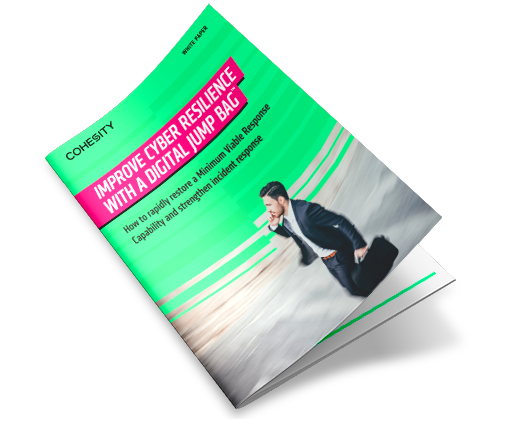
Secure and protect your digital jump bag™ of tools, contacts, and clean images. Rehearse response and recovery processes across IT and SecOps to improve RTO. 

How it works

Follow one repeatable process, from drill to live incident 

prepare
Get your trusted tools and information ready
  • Define your Minimum Viable Company (MVC) 
  • Vault immutable copies and your digital jump bag 
  • Design an isolated environment with its own identity plane 
initiate
Reach your tools and start the response 
  • Declare the incident and activate the isolated environment 
  • Recover your digital jump bag 
  • Restore communications and core services such as identity and DNS 
investigate
Learn how far the attack went
  • Triage each system and move through backups to find the first compromise 
  • Hunt for indicators of compromise and test suspicious files in a secure sandbox 
  • Preserve the evidence 
mitigate
Fix what’s broken before services return 
  • Choose to recover and clean or to rebuild for each system 
  • Patch systems and reset credentials before rescanning 
  • Validate and release after the service owner signs off 
White paper

Start with the digital jump bag

Keep everything your incident responders need in a cyber vault, outside the blast radius, for when production can’t be trusted.

A typical bag holds: 

  • Contacts and an escalation tree 
  • A copy of your insurance policy 
  • Incident response and crisis plans 
  • Forensic and log analysis tools 
  • Clean admin workstation images 
     
CERT

Cohesity CERT (Cyber Event Response Team)

Prepare before. Recover with confidence. CERT is with you before the attack and through it.  

  • Reduce risk from ransomware, data theft, and prolonged downtime: Benchmark your readiness, design your clean room and digital jump bag with experts, and leave with a clear action plan for effective incident response and recovery.  
  • Minimize downtime and data loss: Get incident response expertise and recovery support when an attack occurs, helping your teams dramatically reduce the risk of data loss so your business can recover faster.  
  • Faster response with your incident response (IR) partner: CERT works side-by-side with the world's leading IR firms, so investigations move faster and you recover sooner.  
Roadmap to resilience thumbnail
Your roadmap to ransomware resilience

Minimize the impact of ransomware

Map out your path to stronger cyber resilience—from planning to execution.

FAQs about Cohesity Clean Room

Cohesity Clean Room is an operational cyber recovery capability that helps teams restore critical services to a trusted state after a destructive cyberattack. More than an isolated recovery environment, it brings together the trusted resources, technology, workflows, and decision gates teams need to prepare for and execute incident response and recovery. 

Teams follow four stages: prepare response resources; when an incident is declared, access them quickly to initiate response; investigate in isolation, mitigate threats; and only then bring services back. This approach gives you speed without compromising security.  

An isolated recovery environment provides a separated location where teams can restore and investigate systems. The Cohesity Clean Room goes further by combining that isolation with the trusted resources, workflows, and decision gates required for incident response and recovery. 

Cohesity Clean Room helps teams prepare before an attack, investigate and remediate compromised systems in isolation, validate recovered services, and capture evidence before services return to production. 

The Minimum Viable Company (MVC) is your organization's operational capability to restore its most critical services to a trusted, working state, within impact tolerances. The Clean Room is where your MVC gets executed and proven, giving teams a repeatable process to investigate, remediate, validate, and return those priority services to a trusted state.  

It also puts Step 4 of the Cohesity 5 Steps of Cyber Resilience©, Practice application recovery, into action by helping teams automate the digital jump bag and clean room workflows, so recovery is rehearsed before an attack and efficient during one. 

Loading