
Did you miss Catalyst?
We’ve got you covered. Every session is here, ready to stream on demand.


0APT Ransomware: Tracking a High-Velocity 2026 RaaS Threat
Introduction
In late January 2026, a sudden emergence was observed of a previously unknown ransomware operation operating under the name 0APT. Unlike many ransomware groups that slowly build reputation or test tooling over weeks or months, 0APT entered the threat landscape at full speed - launching dozens of intrusions within its first 48 hours of activity.
Cohesity REDLab has released updates to its threat library in response to this new threat, and this article documents what is currently known about 0APT, why its newness matters, and how its automated, high-tempo kill chain enabled rapid compromises across financial services, healthcare, energy, logistics, and technology sectors in early 2026. While 0APT uses many familiar ransomware techniques, its scale, speed, and coordination of its initial campaign distinguish it from typical early-stage ransomware groups.
0APT in the Current Threat Landscape
In 2026, ransomware ecosystems are increasingly shaped by Ransomware-as-a-Service (RaaS) platforms that allow new brands to appear fully operational on day one. 0APT exemplifies this trend.
Key factors that elevate 0APT’s risk profile:
- Extremely recent emergence first observed January 28, 2026.
- Immediate mass exploitation rather than gradual ramp-up
- Broad, sector-agnostic targeting
- Heavy reliance on automation and affiliate tooling
- Aggressive data-theft-first extortion strategy
Despite the “APT” naming convention, 0APT does not seem like a state-sponsored espionage group. It is a financially motivated ransomware operation optimized for speed, volume, and monetization.
Initial Emergence and Early Campaign Activity
0APT first surfaced publicly on January 28, 2026, when multiple organizations across different industries reported simultaneous ransomware incidents tied to a common leak site and ransom note branding.
Within the first two days:
- 71 confirmed intrusions were attributed to 0APT
- 61 compromises occurred in a single 24-hour window
- Victims were immediately listed on a dedicated leak site featuring public naming, stolen data previews and countdown timers tied to ransom deadlines
This level of activity is unusual for a newly identified ransomware brand and suggests the group launched with pre-existing infrastructure, tooling, and affiliates rather than building capabilities incrementally.
Impacted Sectors
0APT’s targeting strategy appears opportunistic rather than ideological, focusing on organizations with valuable data and operational urgency. Impacted sectors are:
Financial Services
- Claims of multi-terabyte data theft, including:
- SWIFT transfer logs
- KYC documentation for high-net-worth individuals
- Unencrypted financial records
Healthcare
- Hospitals and healthcare networks impacted, increasing patient safety risks
- Theft of clinical and operational data prior to encryption
Energy and Utilities
- Compromised organizations included power generation and grid operators
- Stolen data allegedly included infrastructure diagrams and offshore maps
Transportation and Logistics
- Targeting of logistics providers with threats to release:
- Driver license data
- Cargo manifests
- Route and scheduling information
Technology and IT Services
- Theft of Network topology diagrams
- Theft of VPN credentials
- Theft of Security architecture documentation
Geographically, a significant concentration of victims were based in the United States, though activity was not limited to a single region.
0APT’s Operational Model
0APT operates as a full-service Ransomware-as-a-Service platform, providing affiliates with:
- Ransomware locker binaries
- Phishing-oriented command-and-control infrastructure
- Negotiation and leak-site management
- Data-hosting and extortion support
This model allows affiliates to focus on initial access and execution, while 0APT centralizes branding, payment handling, and public pressure tactics.
Kill Chain Analysis: How 0APT Attacks Unfold
The MITRE ATT&CK Mappings of 0APT are in the table below:
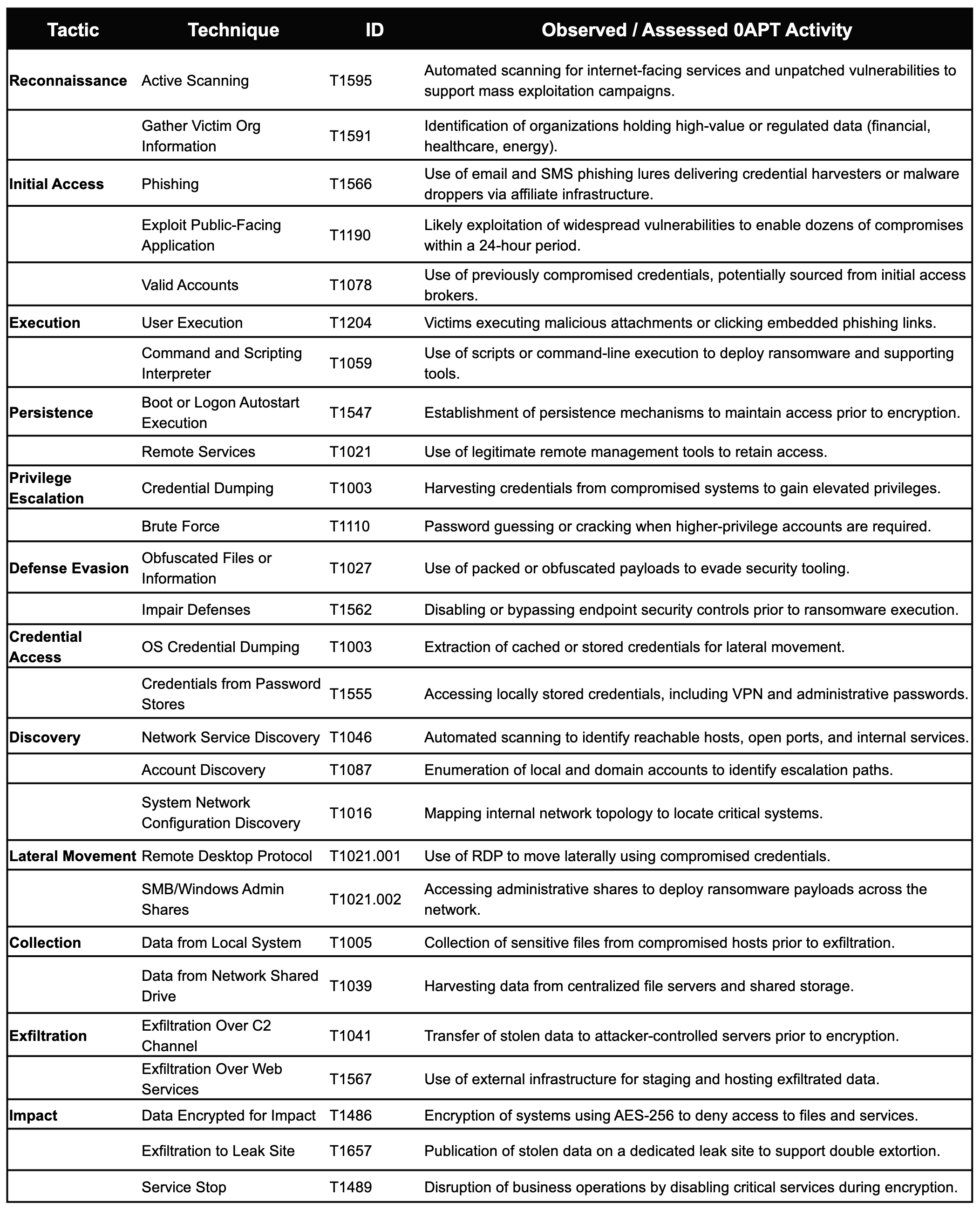
1. Reconnaissance
0APT campaigns begin with broad reconnaissance, likely automated, aimed at identifying:
Internet-facing systems with unpatched vulnerabilities, organizations holding regulated or monetizable data, and environments with exposed remote access services. The rapid volume of compromises suggests scanning for widely deployed, high-impact weaknesses rather than bespoke targeting.
2. Initial Access
While investigations are ongoing, observed activity points to multiple access vectors:
Phishing campaigns, email and SMS-based lures, credential harvesting and malware droppers, vulnerability exploitation, mass exploitation of common server-side flaws, stolen credentials, and likely sources from initial access brokers or prior breaches. The ability to compromise dozens of organizations in parallel indicates repeatable, low-friction access methods.
3. Establishing Persistence
Once inside a victim environment, operators move quickly to retain access by deploying backdoors, leveraging legitimate remote management tools, and maintaining redundant access paths to avoid lockout. Persistence is established early to support data theft before encryption.
4. Internal Reconnaissance
Attackers then map the internal environment to identify - Domain controllers, file servers and backup systems, high-value data repositories. Automated discovery tools accelerate this phase, minimizing dwell time.
5. Privilege Escalation
If initial access does not yield sufficient privileges, 0APT affiliates attempt to escalate by harvesting cached credentials, brute-forcing weak passwords, and reusing credentials across systems. Achieving domain-level access enables rapid lateral movement.
6. Lateral Movement
With elevated privileges, attackers move laterally using Remote Desktop Protocol (RDP), administrative file shares, and compromised domain accounts. The goal is to position ransomware payloads across as many systems as possible before detonation.
7. Data Exfiltration (Primary Extortion Lever)
Before encryption, 0APT prioritizes large-scale data exfiltration, often involving financial records and transaction logs, operational intelligence, proprietary intellectual property, and regulated personal and medical data.
This supports a double-extortion model, where victims face both operational disruption and public data exposure.
8. Impact and Extortion
The final stage involves, simultaneous encryption using AES-256, system lockout and ransom note deployment, victim publication on the 0APT leak site, and countdown-driven negotiation pressure. If ransom demands are unmet, stolen data is released incrementally to increase leverage.
Distinctive Features of 0APT
While 0APT does not introduce novel encryption techniques or previously unseen malware, it stands out for several reasons:
Immediate maturity at launch: 0APT demonstrated a high level of operational readiness from its initial appearance, indicating a well-prepared and professional approach.
Unusually high attack velocity: The group operates at a rapid pace, executing its campaigns with remarkable speed compared to typical ransomware operations.
Strong reliance on automation: 0APT leverages automated tools and processes to streamline attacks and maximize efficiency.
Data theft as the primary pressure mechanism: The group focuses on exfiltrating sensitive data to coerce victims, making data exposure a central component of its extortion strategy.
Clear separation between branding and affiliate execution: There is a distinct division between the 0APT brand and the activities of its affiliates, suggesting an organized structure within the ransomware operation.
These traits suggest that 0APT may be operated by experienced actors leveraging a new brand, rather than by a truly novice group.
Strategies using Cohesity Data Solutions
1. Detect
- Rapid Threat Hunt: Use Cohesity Rapid Threat Hunts to hunt for malware using threat intelligence feeds. These feeds are updated daily with new information from intelligence sources like Google Threat Intelligence, CISA, Cohesity REDLab, Open Source and others. Users can search using default feeds or create custom feeds.
- Threat Scans: Run periodic threat scans using the default threat library that is updated daily or create a custom YARA rules. Users can also use third-part integration and threat intelligence vendors.
- Anti-ransomware: Users are advised to closely monitor the ML-based anti-ransomware backup anomalies in Security Center for detection of ransomware activity.
2. Response and Recovery
- Immutable Backups: Maintain air-gapped, immutable backups to ensure rapid recovery after an attack.
- Automated Recovery: Use solutions like Cohesity’s Recovery Agent for single-click cyber recovery and clean-room restoration.
- Incident Response Playbooks: Prepare for multi-stage attacks with rehearsed response plans and stakeholder coordination.
- Threat Detection: Use threat detection features mentioned above before recovery to make sure that snapshots are clean.
Conclusion
0APT represents a modern ransomware playbook executed at extreme speed. Its rapid rise highlights how the RaaS ecosystem enables threat actors to launch high-impact campaigns with minimal public buildup, catching defenders off guard. Cohesity Products and REDLab’s proactive research and validation provide organizations with the tools and insights needed to detect, respond to, and recover from 0APT and similar threats.
For the latest advisories and technical details, visit Cohesity REDLab.

Start your 30-day free trial or view one of our demos.