

Responsible AI is an approach to developing and deploying artificial intelligence (AI) from both an ethical and legal point of view. The goal of responsible AI is to employ AI in a safe, trustworthy, and ethical fashion.

Join the Cohesity Community
Connect with peers, share expertise, build skills, and enhance your product knowledge in the new Cohesity Community.


Responsible AI
Define what data should be shared with your AI models and protect access to it with RBAC controls. Promote responsible AI, transparency, and accountability around access and policies.
overview
Maximize your potential, minimize your risk
The promise of AI technologies means change for the enterprise. While these advancements bring us into a new era of possibility, they can also come at a cost. So we offer both commitments and safeguards for responsible AI use.

Transparency
Protect access to data with role-based access controls. Promote transparency and accountability around access and policies.

Governance
Help ensure the security and privacy of data used by AI models and the workforce—so the right data is exposed only to the right people with the right privileges.

Access
Access data responsibly via RBAC, non-destructively index the data, then search it and summarize it with speed and efficiency.
INTERACTIVE DEMO
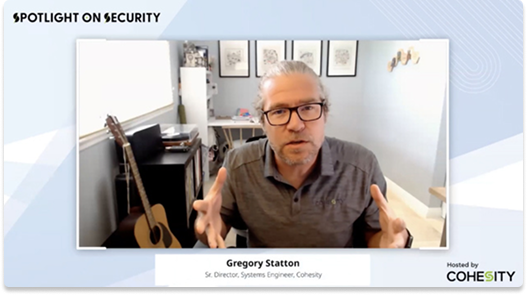
Demo: Usher in a new era in data security and management with AI
Watch as Gregory Statton, Office of the CTO - Data & AI, talks about Cohesity's vision for AI, including helping customers reduce their time to action through Operational Insights. He also shows the advancements in search and discovery using retrieval augmented generation (RAG) to drive rich conversations with data.
Benefits
Retrieval augmented generation (RAG) AI in action
Start having a conversation with your data. Using common language, ask questions about your data and await responses. Ask follow-up questions, dig deeper into datasets, and let Cohesity Gaia support more in-depth data analysis.
Conversational data
Use natural language to create queries that can unlock deep learnings and insights hidden in your data.
AI-powered search
Advanced search capabilities, powered by RAG AI technology, can deliver informed answers to questions hidden in your business and application data.
Turning data into knowledge
Gain deep, meaningful insights and learnings into your organization and data.
VIDEO
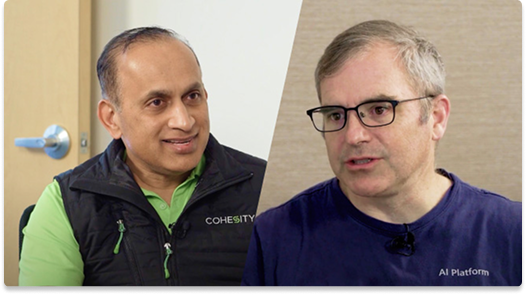
Using AI to unlock insights from enterprise data
See our shared vision for how customers of Microsoft and Cohesity can securely use AI to transform data security initiatives.
Testimonials



- Infra Fürth
- JSR Corporation
- Moor Insights & Strategy
- Google Cloud
More AI use cases for the enterprise
Learn more about responsible AI and data governance
Generative AI uses algorithms to generate new content (written content, images, video, audio, and computer code, etc.) based on user input. Unlike earlier versions of AI, generative AI can create new content, like news articles, poetry, or cyber threat analyses, presented in a conversational UI.
Conversational AI mimics human conversation and speech using techniques such as NLP and transformers to generate personalized responses.
Cognitive AI uses techniques such as natural language processing (NLP) and machine learning (ML) to mimic human cognitive abilities.
Retrieval AI searches information from large datasets, and uses AI techniques to retrieve the most relevant results matching the intent of the user's query.
AI can enhance data management and make it more efficient, such as by automating data classification or detecting anomalies.
Cohesity built AI into several of our products to help detect threats, classify large volumes of unstructured data, and protect critical data and workflows.
Two ways we use AI include:
We use AI to boost data security. We can secure data and strengthen your cyber resilience with threat detection and data classification.
We help you get more from your stored data. Cohesity Gaia is an AI-powered data insights solution that can conduct semantic searches and create answer summaries from your enterprise data. Using your backups as a data source, Cohesity Gaia can unlock the knowledge in your data.




Product demos
Customize your demo experience and see our data security and management in action.

30-day free trial
Use the cloud for backup, cyber vaulting, or rapid recovery from cyber threats or disasters.

Meet with us
Meet with a security specialist to identify your risk and build a protection plan.
Loading